

Enat Bank S.C., long a byword for gender- responsive banking, has unveiled its next breakthrough, launching the country's first Gender Bond.
The deal, now in preparation under the guidance of transaction adviser, i-Capital Institute Plc, will channel long-term funding to women- owned and women-led enterprises and to social infrastructure that supports women in housing, healthcare, childcare and education.
By affixing a capital-markets label toits longstanding mission, Enat Bank is extending its inclusive ethos beyond its branch network and into the portfolios of institutional investors seeking both returns and measurable social impact. It embodies its founders' vision.
By affixing a capital-markets label toits longstanding mission, Enat Bank is extending its inclusive ethos beyond its branch network and into the portfolios of institutional investors seeking both returns and measurable social impact. It embodies its founders' vision.
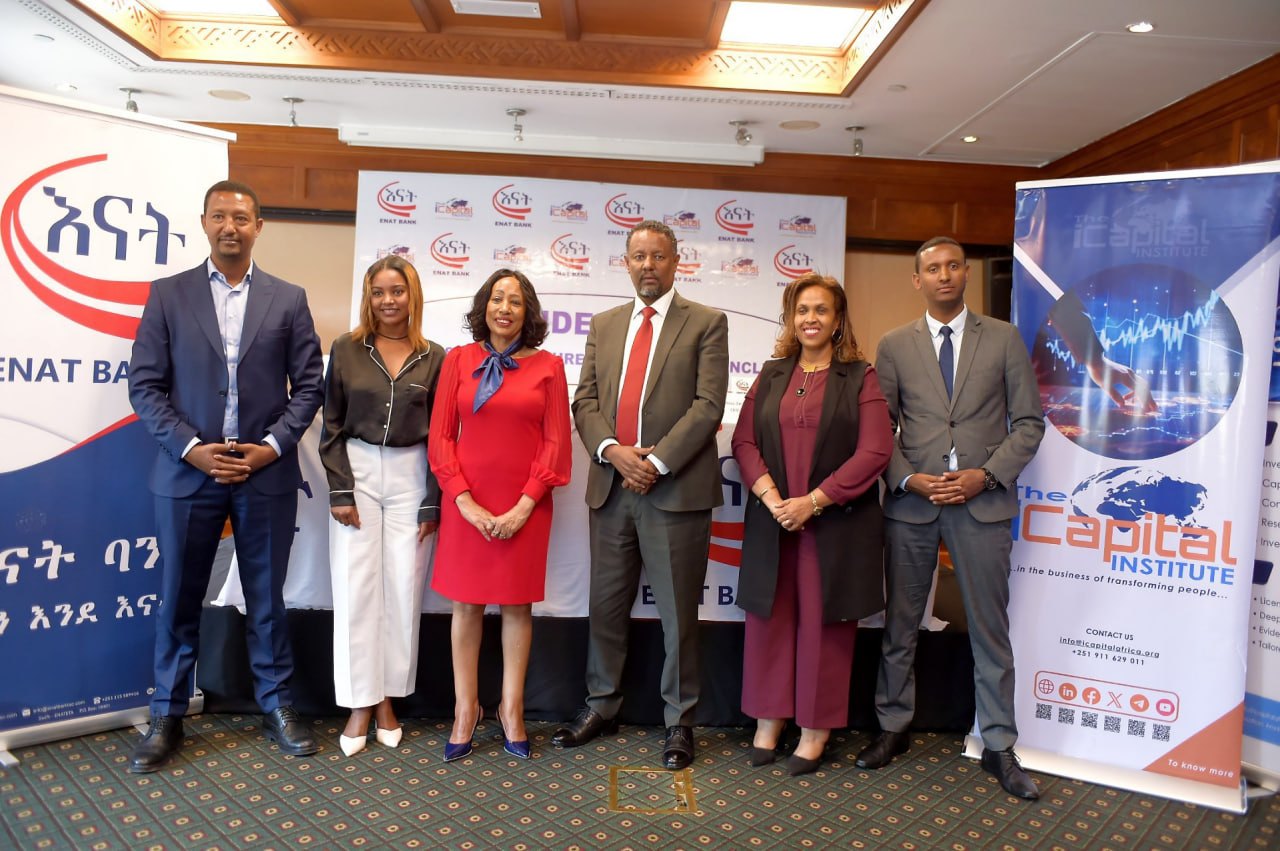
Backed today by a shareholder base that is J4 pc women, more than half of its board of directors and senior management women, Enat Bank has its debut in Gender Bond at an event held at the Sheraton Hotel on November 13, 2025.
The proposed bond is being structured to meet the Social Bond Principles of the International Capital Market Association, the yardstick global investors use to judge credibility and transparency in socially themed debt.
According to Gemechu Waktola (PhD), the CEO of i-Capital, the alignment is deliberate."Just four or five years ago, the capital market was just an idea," he recalled. "It's unthinkable to realize it."
His firm has worked with Enat Bank from the outset, steadily building human capital, and is now weaving the reporting, monitoring and governance requirements investors expect from an ICMA-aligned bond into the nascent capital market framework. Enat Bank's step into the arena will put Ethiopia on the gender-inclusive map and prove to regulators, financiers and entrepreneurs that the domestic market can handle sophisticated thematic instruments.
The Gender Bond dovetails neatly with national policy, the second edition of the National Financial Inclusion Strategy, which calls for narrowing the gender gap in access to finance. The National Bank of Ethiopia (NBE) has already granted Enat Bank its only" Transformational" score in the regulator's Gender Financial Inclusion Index, recognising the Bank's track record of tailoring products for women borrowers and savers.
The bond also resonates with the global Sustainable Development Goals (SDGs). By translating those policy ambitions into a tradable security, Enat Bank gives fund managers, especially those with environmental, social and governance (ESG) mandates, a mechanism to express conviction about gender equality while earning a coupon.
What distinguishes a Gender Bond from the conventional?
Gender Bond from the conventional funding tools familiar to depositors is the ring- fenced use of proceeds. Demand deposits let customers keep cash liquid (withdrawable on sight) but do little to lengthen the financial system's funding tenor.
Time deposits lock money away and pay a premium rate, yet still only recycle household savings. Thematic bonds, such as the ones Enat plans, raise wholesale funds ear markedexpressly for projects fighting gender inequality.
Investors buy a security that promises financial return and a quantifiable social dividend. In practice, more capital flows to women-run farms, cooperatives and micro-,small-and medium-sized businesses. More financing for clinics and daycare centres, and more resources for training programs that help women climb into management, could be realized.
Enat Bank's chair woman, Aster Solomon, sees the issue from the ground up. Enat Bank recently hit the five-billion-Birr minimum paid-up capital threshold set by regulators, a milestone she called "a huge step" Since its founding in March 2013, the Bank has offered women depositors slightly higher rates and extended uncollateralized loans to women entrepreneurs.
This is funded in part by a collateral-risk pool built from three to five percent of shareholders' profits and by agreements with volunteer depositors who pledge balances as backstops.The bond formalities what the Bank has practiced for years in mothering customer’s toward economic independence.
Complementing finance with know-how, Enat Bank runs training in financial management, a service that helped earn its transformational rating.
We're determined to include women
In rural areas financially, in sectors like agriculture," said Aster. At today's pace, experts calculate it will take the world 131 years to close overall gender gaps and 1J) years to close economic gaps. By 2030, more than 340 million women and girls are projected to live in extreme poverty, including 220.) Million in sub-Saharan Africa. The funding gap for women- owned MSMEs alone runs between1.4 trillion and 1.7 trillion dollars by some estimates, while African women entrepreneurs face a 42 billion dollars shortfall.
However, women borrowers default less frequently. Banks in sub-Saharan Africa reported 53pc lower non-performing loan (NPL) ratios for women borrowers in 2023. For investors, the numbers point to a Gender Bond that can be as prudent as it is purposeful.
Other African markets have begun to test the premise. Since 2021, Morocco, Rwanda, South Africa and Tanzania have all issued gender-linked notes. Morocco’s Banque Centrale Populaire paved the way. Tanzania's NMB Bank followed with its Jasiri Gender Bond in 2022, mobilising millions for womenled ventures. South Africa's Barloworld Limited placed an approximately 58 million dollar instrument, stoking workplace diversity.
Rwanda has tapped its own market.Each of these deals attracted development finance institutions and ESG-minded funds while teaching local intermediaries how to verify, allocate and report on gender outcomes. Ethiopia's turn, when it comes, will place the country alongside that cohort.
Credibility, however, rests on rigour. The FSD Africa Toolkit counsels issuers that gender bonds should tie their promises to internationally recognised standards or risk being dismissed as pinkwashing. ICMA's four-part framework (defining how proceeds may be used, projects are selected and evaluated, money is managed, and results are reported) offers one solution. Supplementary guidance from UN Women, the International Finance Corporation (IFC), and ICMA outlines best practices.
The Orange Bond Initiative, whose aim is to unlock 10 billion dollars for gender lens investments by 2030 and reach 100 million women and girls, sets an ambition that helps rally investors. By following these playbooks, Enat Bank hopes to satisfy the diligence requirements of multilateral lenders and private asset managers alike. For Gemechu of I Capital,the exercise is as much about ecosystem building as it is about a single transaction. Years ago, he had thought it "unthinkable to realise a functioning capital market in Ethiopia. Today, Parliament has passed the legal scaffolding and licensed market operators. He now sees Enat Bank’s bond as a "proof of concept" not only for future gender instruments but for social, green and sustainability- linked bonds too. Successful execution could embolden other banks and corporates to explore similar routes, broadening the menu of local-currency options for long-term finance.
Investors will likely pay close attention
Investors will likely pay close attention to the bond's structure.However,questions include tenor,coupon, and credit enhancement. Will development institutions provide guarantees and reporting frequency?
Global precedents show appetite exists. Social bonds worldwide raised more than 150 billion dollars in 2023, up sharply from a decade earlier. In frontier markets, multilateral backing often helps crowd in private capital. Should Enat Bank secure such support, its issue could clear price and rating hurdles more quickly.
For policymakers, the bond aligns with efforts to diversify funding sources. Domestic banks traditionally rely on deposits and central-bank facilities, while companies depend on retained earnings and banks. A functioning bond market can match long-term projects with institutional investors such as pension funds and insurers. Adding a gender lens further enlarges the pool, tapping ESG portfolios that have grown into a multitrilliondollar segment.
Aster believes the narrative advantage matters too. Enat Bank's founding story resonates with stakeholders precisely because it is rooted in experience."For women entrepreneurs, Enat Bank has been the mother to all its customers," she said. The Gender Bond packages that story into a security that investors can buy.
It also demands transparent allocation, rigorous impact reporting and accountability if targets are missed. Enat Bank, accustomed to tracking social metrics to satisfy regulators and donors, appears comfortable with that discipline.
News source Addis fotune